
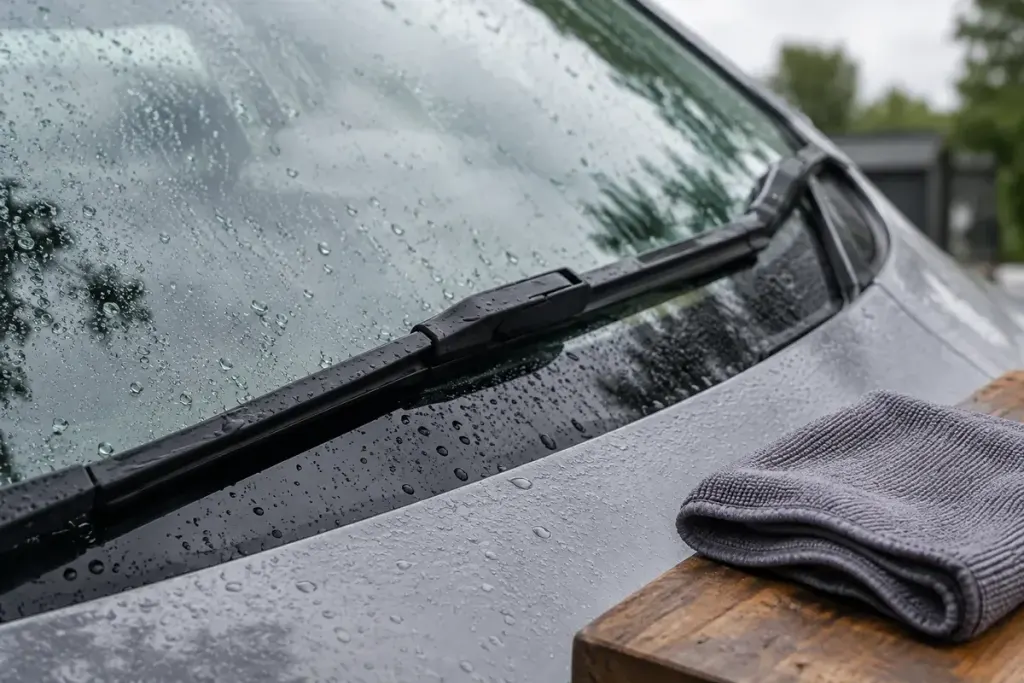
The wipers move, but a thin smear stays directly in your line of sight. It is tempting to order a new pair immediately. First, give the glass and blade a careful look while the car is safely parked. The pattern of the problem can help you describe it and avoid buying parts without checking their fit.
This is a basic observation and cleaning routine. It is not a reason to keep driving with poor visibility. If you cannot see clearly, stop somewhere safe and address the problem before continuing.
Begin with the surface the blade is crossing
Check the windscreen for visible dirt, residue and anything that could affect the wiped area. Use cleaning products and methods suitable for the vehicle, its glass and any coatings, following the owner’s manual and product instructions. A clean cloth matters: moving old residue around can make it hard to tell what improved.
Check washer-fluid guidance too. Do not improvise a mixture because a household cleaner looks similar. Take note if the washer spray does not reach the expected area; that is a separate observation from a damaged wiping edge.
Inspect without letting the arm snap back
Some vehicles require a specific service position before a wiper arm can be lifted. Consult the manual first. Handle the arm carefully and protect the glass as instructed; a spring-loaded arm must not be allowed to strike the windscreen. If access is awkward, ask a workshop to carry out the inspection.
Look at the wiping edge without pulling or cutting the rubber. Note obvious splits, distortion or missing sections. Bosch lists streaking, chattering and visible rubber deterioration among signs that wipers may need replacement. Those signs help frame an inspection, but they do not identify every possible cause on every vehicle.
Test on wet glass while stationary
After cleaning according to the relevant instructions, test the wipers with the car stationary and the glass properly wet. Keep hands and cleaning materials clear of moving parts. Observe where the streak begins, whether it repeats in the same place and whether there is an unusual noise.
A quick note can be useful: “Driver-side blade leaves a narrow unwiped strip near the centre after cleaning” is more informative than “wipers bad.” If cleaning improves the result only briefly, mention that as well. Avoid guessing that extra pressure or bending the arm will solve it.
Buy for the vehicle, not just the apparent length
If replacement is needed, confirm the vehicle, model year, blade position and attachment system using the manufacturer’s information or a reliable fitment catalogue. Front blades may differ from one another, and the rear blade can use a different arrangement. A packet that looks the same size is not enough evidence.
Follow the fitting instructions and check that the replacement is secured before use. If streaking or chatter persists with correctly fitted suitable blades and clean glass, have the system inspected rather than repeatedly buying another set.
The useful outcome is clear wet-weather visibility and an explanation of what was checked. A small maintenance note can save you from repeating the same uncertain diagnosis the next time rain arrives.