
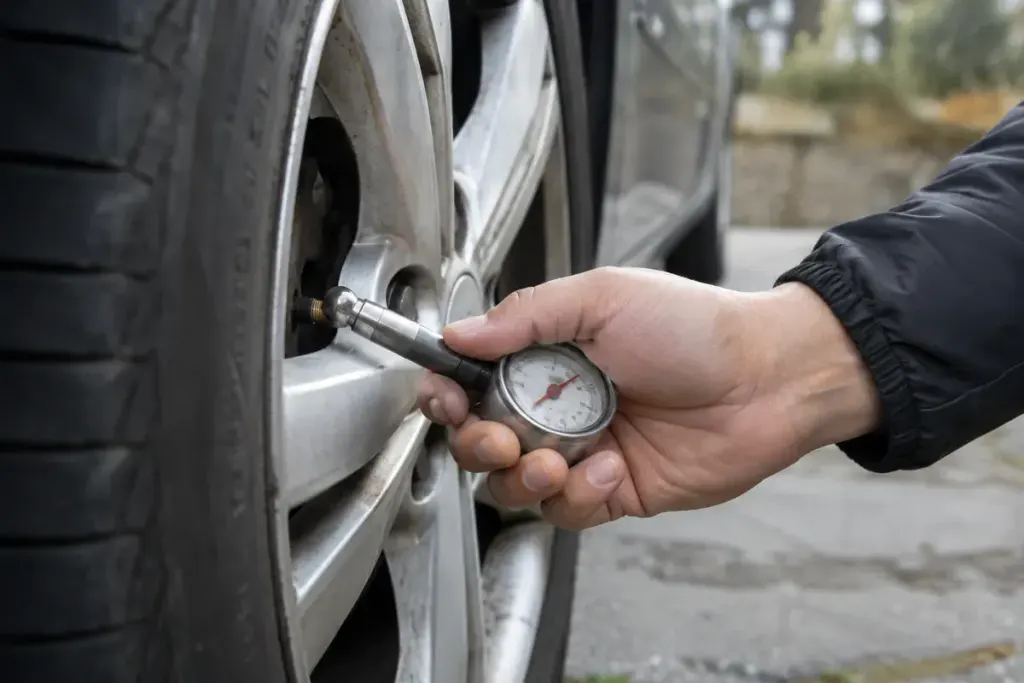
A tyre-pressure check is more useful when you know what you are comparing. A number from the gauge, a different number on the tyre sidewall and a warning light on the dashboard can otherwise turn a small maintenance task into guesswork.
Begin with the car’s own information. Find its recommended cold pressures on the vehicle placard or in the owner’s manual, including any differences for front and rear tyres or loading conditions. Do not adopt a pressure simply because it worked on another car.
Find the target before you use the gauge
NHTSA’s tyre-safety guidance directs drivers to the vehicle manufacturer’s recommendation, rather than the maximum pressure printed on the tyre. The same guidance recommends checking tyre pressure regularly, including a monthly check. Use the units shown by your gauge and the vehicle information consistently.
If you cannot identify the correct specification for the fitted tyres and vehicle configuration, ask a qualified tyre professional. A photograph of the placard and a note of the tyre markings can make that conversation easier, but a generic internet chart is not a substitute for the right specification.
Choose the conditions for the check
Park safely away from traffic and check the manual for the procedure. NHTSA describes cold tyres as tyres on a vehicle that has not been driven for at least three hours in its cold-weather driving guidance. A reading taken after driving may not be directly comparable with a cold reading.
Keep the valve cap somewhere you can find it. Seat the gauge carefully and repeat a reading if the connection was poor. Follow the vehicle and gauge instructions for adjusting pressure. Do not release air simply to force a warm tyre down to a cold-pressure target.
Write four readings, not “tyres checked”
A practical log has a date, the check conditions, the target for each axle and a reading for each wheel. Add whether an adjustment was needed. Label the wheels consistently—front left, front right, rear left and rear right—so a pattern remains visible next month.
For example, a blank note might read: “Cold check, parked overnight; front target from placard ___; rear target ___; FL ___, FR ___, RL ___, RR ___.” The spaces are intentional. The correct numbers must come from your vehicle, not this article.
Use repeated changes as a question for the workshop
If one tyre repeatedly differs from the others or loses pressure between checks, record what you observed and arrange an inspection. Repeatedly topping it up without investigating does not explain the cause. A dashboard monitoring system is useful, but it does not replace reading the manual or checking visible damage.
Do not continue driving on a visibly flat or seriously damaged tyre to complete a routine log. Bulges, cuts and other concerning damage need professional attention. Follow the vehicle’s instructions for breakdown situations and spare-wheel arrangements.
A good record takes little space. Its value is that next time you have a starting point: the right specification, comparable conditions and enough detail to explain what changed.