
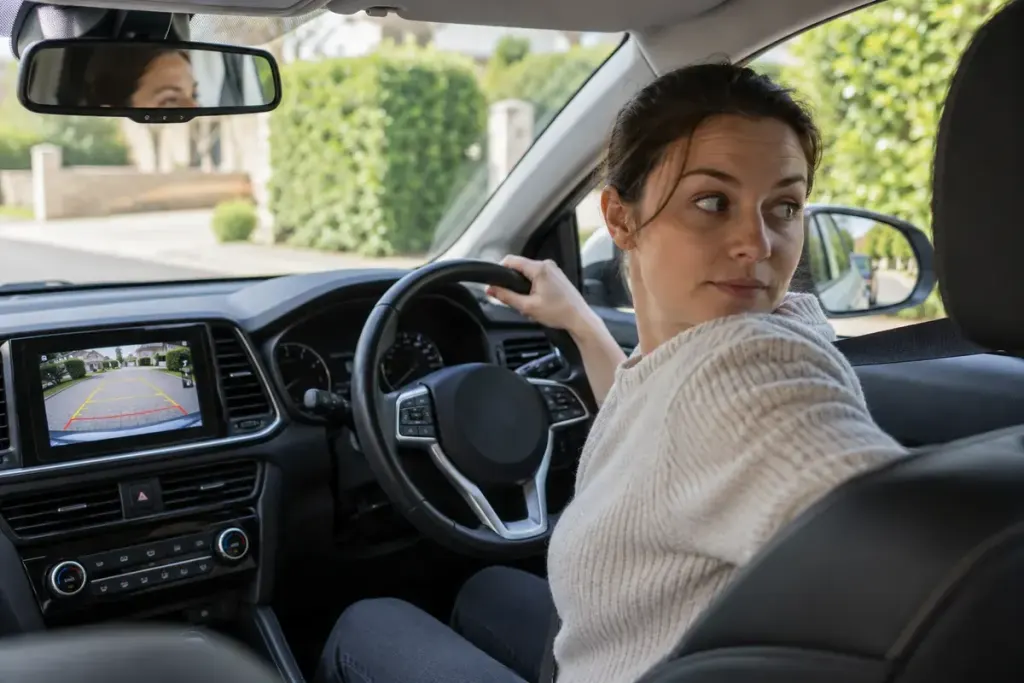
A clear camera picture can feel like a complete view of the space behind a car. It is still one camera’s view, with a particular angle, lens and set of limits. Someone approaching from the side may enter that view only after you have begun moving.
NHTSA describes a backup camera as a rearview video system that helps drivers see behind the vehicle while reversing. Camera images, parking sensors and automatic braking are different functions; the presence of one does not prove that the car has the others.
Learn the picture while the car is stationary
Read the manual’s explanation of the displayed lines and warnings. Some lines move with steering angle, while others have another purpose. Do not assume they measure every obstacle’s exact distance or predict clearance at the front corners.
Keep the lens clean using the manufacturer’s recommended method. Rain, dirt, glare and darkness can reduce the usefulness of the image. If the picture disappears or becomes unreliable, stop and resolve the visibility problem rather than continuing on the assumption that the last clear frame still describes the scene.
Keep checking as the situation changes
Before moving, check the area around the vehicle and use the direct views and mirrors available to you. Reverse slowly enough to stop when the situation changes, following local driving rules and your vehicle’s instructions. A previously empty driveway is not guaranteed to remain empty.
An illustrative mistake is watching only the centre of the screen while turning. The rear may appear clear while another part of the vehicle moves towards an obstacle. Treat steering and clearance as a whole-vehicle problem.
Never use a child, pedestrian or animal as a test target for a camera or braking feature. If you need help learning the system, use the manual and suitable professional instruction in a controlled setting.
A reversing camera is valuable precisely because it adds information. It works best when that information joins a careful observation routine rather than replacing one.