
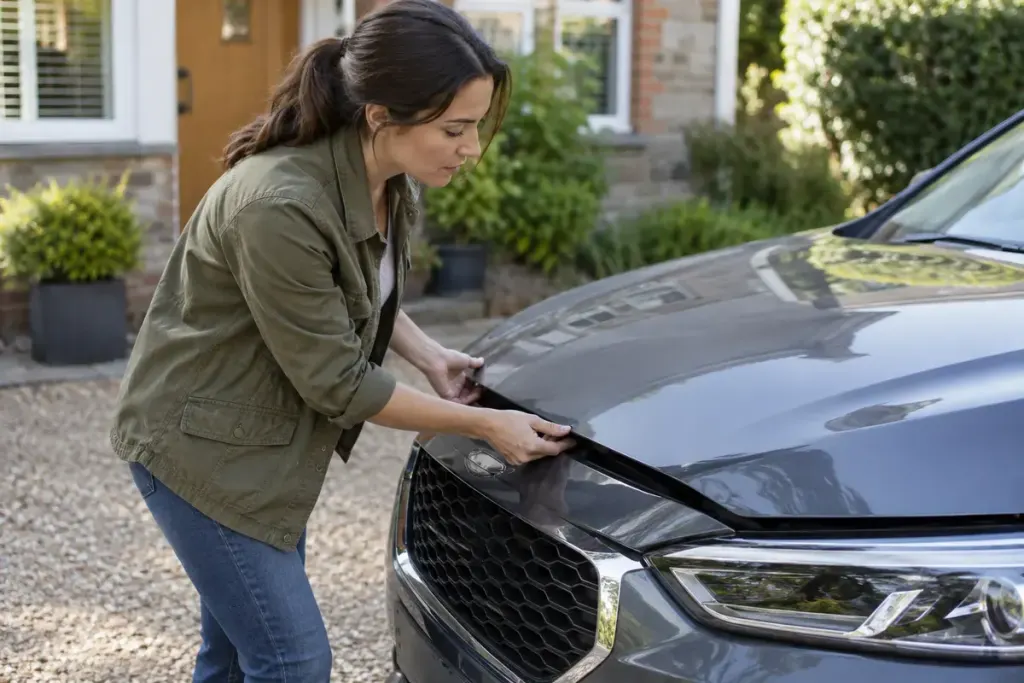
You finish checking washer fluid, lower the bonnet and hear a click. Before walking away, confirm that the bonnet has actually latched. A panel resting near its normal position is not enough evidence on its own.
The Ford Mondeo owner’s manual explicitly requires checking that the bonnet lock is fully engaged. Use the corresponding manual for your own model: the closing method, support arrangement and warning system can differ.
Finish the work before moving the panel
With the vehicle safely parked and the relevant work complete, remove tools and loose items from the engine compartment. Make sure any support rod is returned exactly as instructed. Keep hands, clothing and other people clear of the closing path.
Follow the specified lowering or release method. Do not assume the correct technique is to press hard on the centre of the panel, repeatedly slam it or copy the closing height used on another car. Those choices can damage a panel or fail to engage its lock properly.
Take an unexpected warning seriously
If the vehicle shows an open-bonnet warning or the panel does not sit as expected, stop and investigate safely before driving. Reopen it according to the manual and look for an obvious obstruction. Avoid putting fingers into a latch mechanism or trying to defeat a switch to silence the warning.
Persistent difficulty calls for a qualified repairer. A secondary safety catch is not permission to drive with the primary latch unsecured. Nor should a strap or improvised tie be treated as a substitute for a working lock.
Build the final check into the same routine as collecting your tools. It takes little time, and it provides a clear finish to a job that otherwise ends with an assumption. If you cannot confirm secure closure, keep the vehicle out of use until the problem is assessed.