
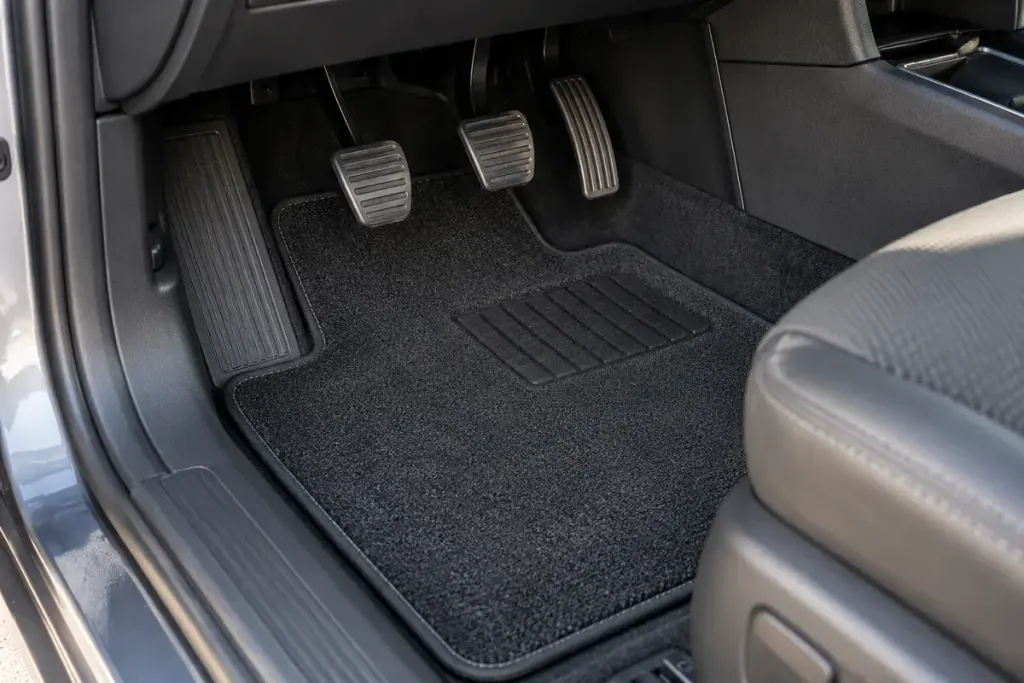
A floor mat looks like a minor interior accessory until its edge reaches a pedal. After cleaning the cabin or fitting a replacement, give the driver’s footwell a deliberate inspection before driving. A tidy-looking mat is not enough if it moves or has the wrong shape.
Toyota’s 2021 RAV4 floor-mat instructions, for example, specify correctly fitting mats and retaining clips and warn against stacking mats. That is a vehicle-specific reference: use the instructions for your own model and year rather than assuming that its fixings work the same way.
Inspect the mat while the vehicle is safely parked
Follow the owner’s manual for securing the vehicle and checking pedal clearance. Remove loose objects from the driver’s footwell. Look for a folded corner, a mat fitted on the wrong side, or an aftermarket cover lying on top of the original.
Check every designated retainer. A fixing that appears close to a hole but does not actually engage is not doing its job. Do not create an improvised fastening or cut a mat to make it fit without appropriate manufacturer guidance.
Replacement questions worth asking
- Is this product specified for the exact vehicle and driving position?
- Does it use the intended retention system?
- Are installation and cleaning instructions supplied?
- Will the seller accept a return if fitment is incorrect?
A product photograph may show a similar interior without proving compatibility. Compare part information with the vehicle details and ask the supplier to resolve uncertainty before use.
Repeat the inspection after anyone removes the mats for washing. If a mat cannot be secured or interferes with a pedal, do not drive with that obstruction in place; resolve the fitment issue first. If a pedal still does not operate normally after the footwell is clear, have the vehicle assessed by a qualified technician rather than blaming the mat and continuing.