
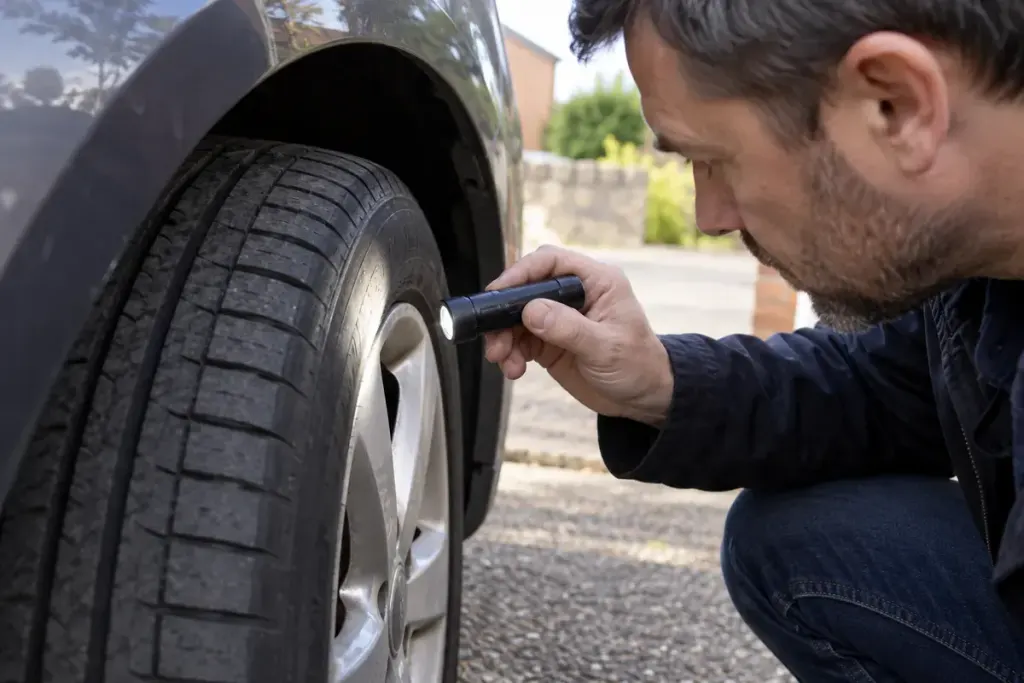
A tyre with plenty of tread can look reassuring, particularly on a car that is driven infrequently. But tread depth does not tell the whole story. Age, condition, use and storage all belong in a tyre assessment.
NHTSA’s tyre-safety guidance explains tyre ageing and how the manufacturing date appears in the tyre identification number. It also advises following vehicle and tyre manufacturer recommendations rather than assuming a good-looking tread guarantees remaining service life.
Read the date without guessing
For a modern tyre using the relevant DOT marking, the final four date-code digits identify the week and year of manufacture. The complete marking may not be visible on the outward-facing side. Ask a tyre professional if you cannot locate or interpret it; do not crawl beneath an unsupported vehicle.
Record the information for each tyre, including the spare if fitted. A replacement fitted on one date was not necessarily manufactured on that date, and a spare may be older than the tyres currently on the road.
Use age as a question, not an inspection result
Look for the replacement and inspection guidance applicable to the exact products and vehicle. There is no single age calculation that accounts for every tyre’s history. Visible cracking, bulges, damage or changes in driving behaviour deserve professional attention regardless of the date code.
When buying a used car, ask about tyre replacement records alongside maintenance records. If a seller says the tyres are “nearly new”, clarify whether that means recently bought, recently made or simply low mileage.
A dated note makes future conversations easier: position on the vehicle, tyre model, manufacturing code and inspection advice. Keep pressure and tread checks in the routine as well. Adding age to the picture improves the questions you ask; it does not replace a proper condition assessment.