
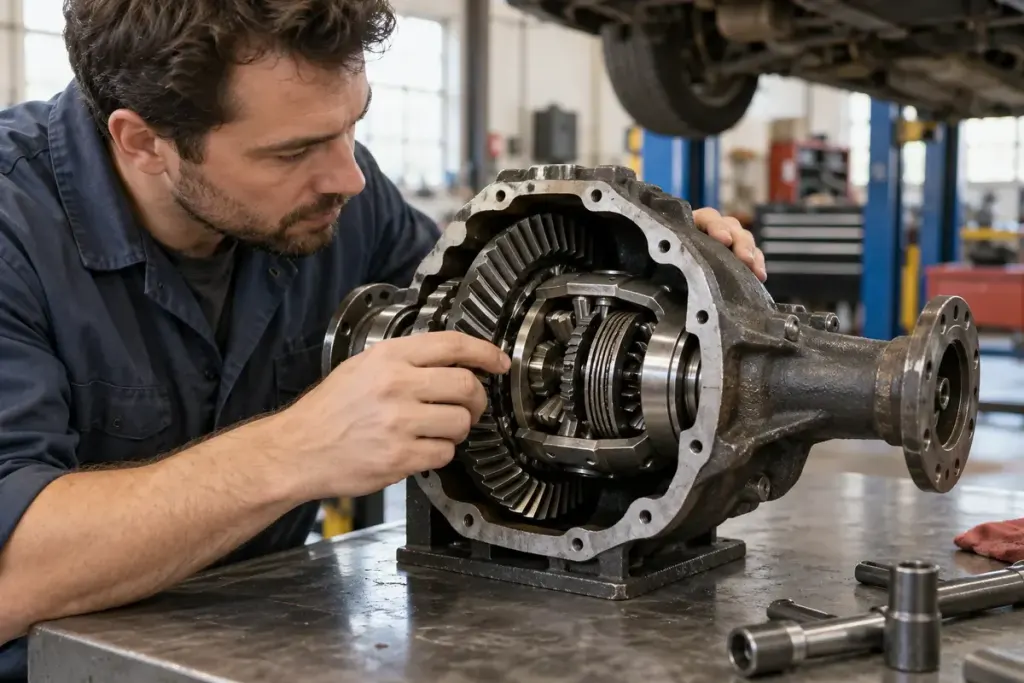
When a car turns, its driven wheels may need to rotate at different speeds. A differential accommodates that difference. A limited-slip design also changes how torque can be shared when the available grip or loading differs between the wheels.
Limited-slip is a family of mechanisms, not one universal response. Clutch-based, helical and electronically controlled arrangements have different characteristics. Identify the actual system fitted to the vehicle before interpreting a brochure’s abbreviation.
A ratio needs something to multiply
Torsen explains torque bias ratio as a way to describe how much more torque its differential can support on the side with better traction. Its illustrative 2:1 ratio is not a claim that every vehicle always sends two-thirds of its torque to one wheel.
The ratio describes a relationship under applicable conditions. It is not a fixed driving mode, and it should not be confused with a locked axle that forces the wheels to rotate together. Other components and vehicle controls may also affect the result.
For a buyer comparing used cars, ask whether the differential is original, which specification applies and whether any required servicing is documented. “Upgraded diff” is too vague to establish compatibility, condition or the intended use of the modification.
Keep the maintenance specific
Use the manufacturer’s lubricant specification and service guidance. Do not add a friction modifier simply because another limited-slip unit needs one. A product suitable for one design may be inappropriate for another.
Unusual noise, binding or a sudden change in behaviour deserves professional assessment. Avoid testing traction limits on public roads to identify the system. Understanding the mechanism helps you ask better questions about a car; it does not replace the vehicle’s operating instructions or make poor conditions safe.