
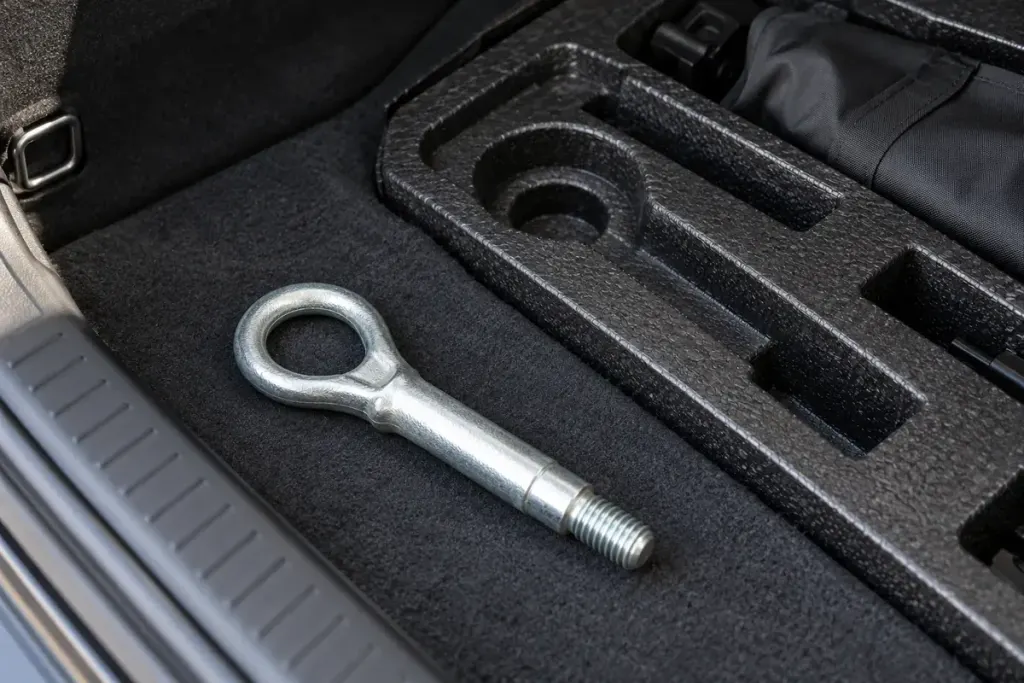
The small threaded metal loop in the boot toolkit is easy to overlook until a recovery operator asks for it. Finding the towing eye while the car is safely parked gives you time to check what it is actually designed to do.
A removable towing eye is not automatically an off-road recovery point or permission to tow the car any distance on its wheels. Use the instructions for the exact model, drivetrain and model year. Electric vehicles and different transmissions can have particularly specific transport requirements.
Make a location check, not a towing experiment
Locate the tool, its storage space and the relevant manual section. Check that the eye belongs to the car; a similar-looking threaded part may not fit. Find the illustrated access cover, but do not force trim or test the fitting by attaching a rope.
For a model-specific example, Volvo’s XC90 towing-eye instructions describe fitting and recovery use. Those instructions should not be copied onto a different car merely because both have a screw-in eye.
Keep the manual accessible offline and leave the tool where the driver can find it without emptying every bag. If it is missing, obtain the correct replacement through a reliable parts source using the vehicle details.
At a breakdown, let safety lead
Do not stand in a live traffic lane looking for a bumper cover. Follow local roadside safety guidance and the recovery service’s instructions. Tell the operator about the drivetrain, any damage and whether the vehicle can select the required transport mode.
Never attach a line to an unapproved suspension or body component because it looks strong. The useful preparation is knowing where the proper equipment and instructions are—not practising an improvised recovery. A few calm minutes at home can prevent a much more hurried guess beside the road.